
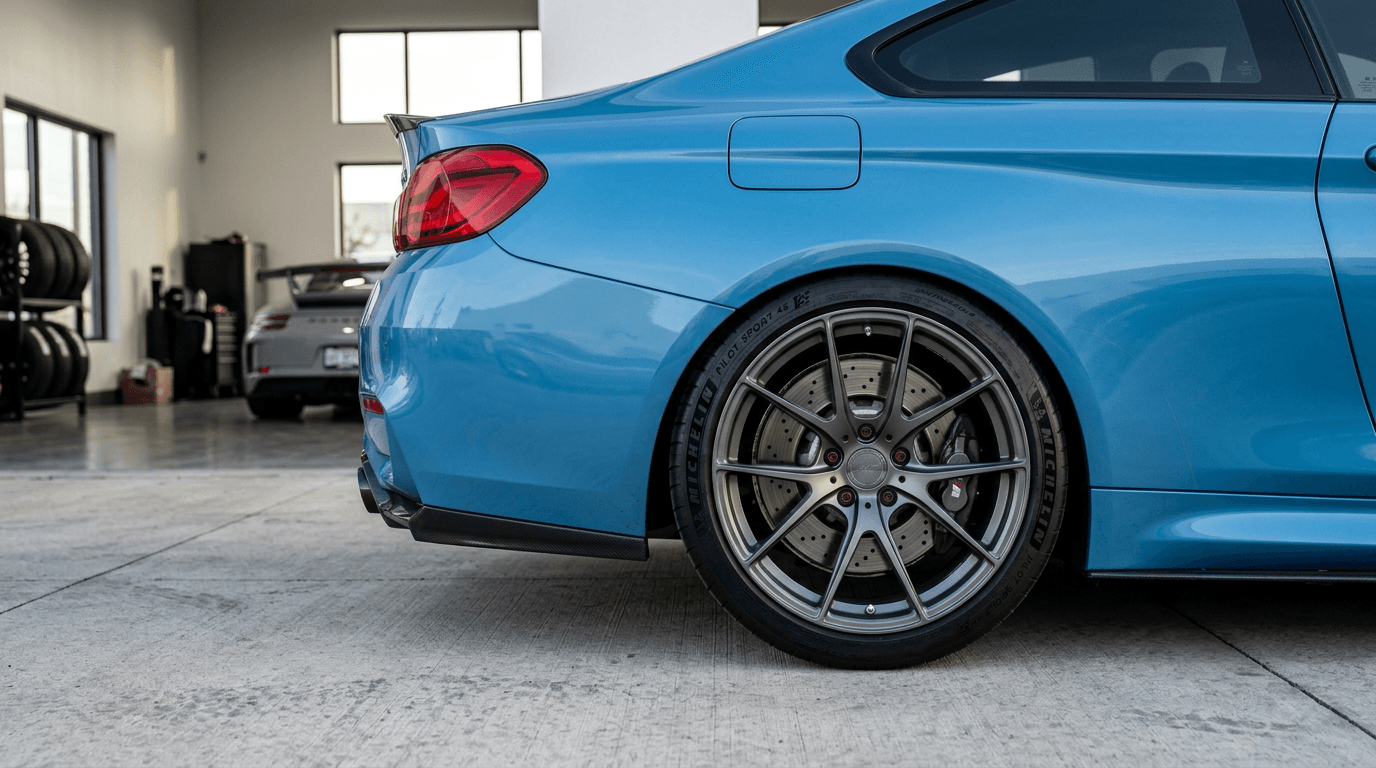
Wheel offset vs backspacing
Understand where your wheels will sit. Learn how offset and backspacing change tuck, flush, and poke, and what to check before buying.
Offset and backspacing describe the same fitment problem from two angles. Learn both, and it gets much easier to predict tuck, flush, or poke.
This guide keeps it simple: definitions, quick rules, and a practical way to estimate wheel position before you buy.
Quick definitions
| Term | What it means |
|---|---|
| Offset (ET, mm) | Distance from the wheel centerline to the hub mounting surface. Positive = more inward. Negative = more outward. |
| Backspacing (in) | Distance from the hub mounting surface to the inner wheel lip. Higher = more inward (in most cases). |
| Wheel width | Usually quoted bead-seat to bead-seat (for example, 9.5). The physical outside-to-outside width is often about 1 inch wider because of the lips. |
| Centerline | Half of the wheel's overall width. Offset is measured relative to this centerline. |
| Flush / Poke / Tuck | Fitment slang describing where the wheel/tire sits relative to the fender line: flush (even), poke (out), tuck (in). |
Real-world fitment context
Fitment decisions happen on real cars, not just charts. Start with a realistic view, then apply the numbers.
Three quick rules
- More positive offset = more tuck. The wheel sits farther inward. Inner clearance gets tighter (strut, control arms, brake components).
- More negative offset = more poke. The wheel sits farther outward. Outer clearance gets tighter (fender lip, liner, bumper tab).
- Wider wheel changes both sides. Increasing width pushes the inner and outer edges outward unless you compensate with offset/backspacing.
Flush vs poke vs tuck
Offset alone does not decide the final look. Tire width, camber, ride height, and fender shape all change how the same wheel spec sits.
Practical takeaway: use offset and backspacing to estimate inside and outside risk, then verify the look on your car photo.
How far does offset move the wheel?
A solid rule of thumb: a 10 mm offset change moves wheel position by about 10 mm.
- +35 to +25: roughly 10 mm outward (more poke).
- +25 to +40: roughly 15 mm inward (more tuck).
How width and offset work together
Width changes both sides of the wheel. Offset then shifts the whole wheel inward or outward.
- Adding 1 inch of width: about 12.7 mm goes inward and about 12.7 mm goes outward, before offset changes.
- Then apply offset change: add or subtract the offset difference to estimate final movement.
Quick conversion: offset and backspacing
Listings may show offset (mm) or backspacing (in). You can convert between them, but use overall wheel width for the math.
- Backspacing (in) ~= (overall width / 2) + (offset mm / 25.4)
- Offset (mm) ~= (backspacing in - (overall width / 2)) x 25.4
How to measure backspacing at home
If you have the wheel in front of you, this takes a few minutes.
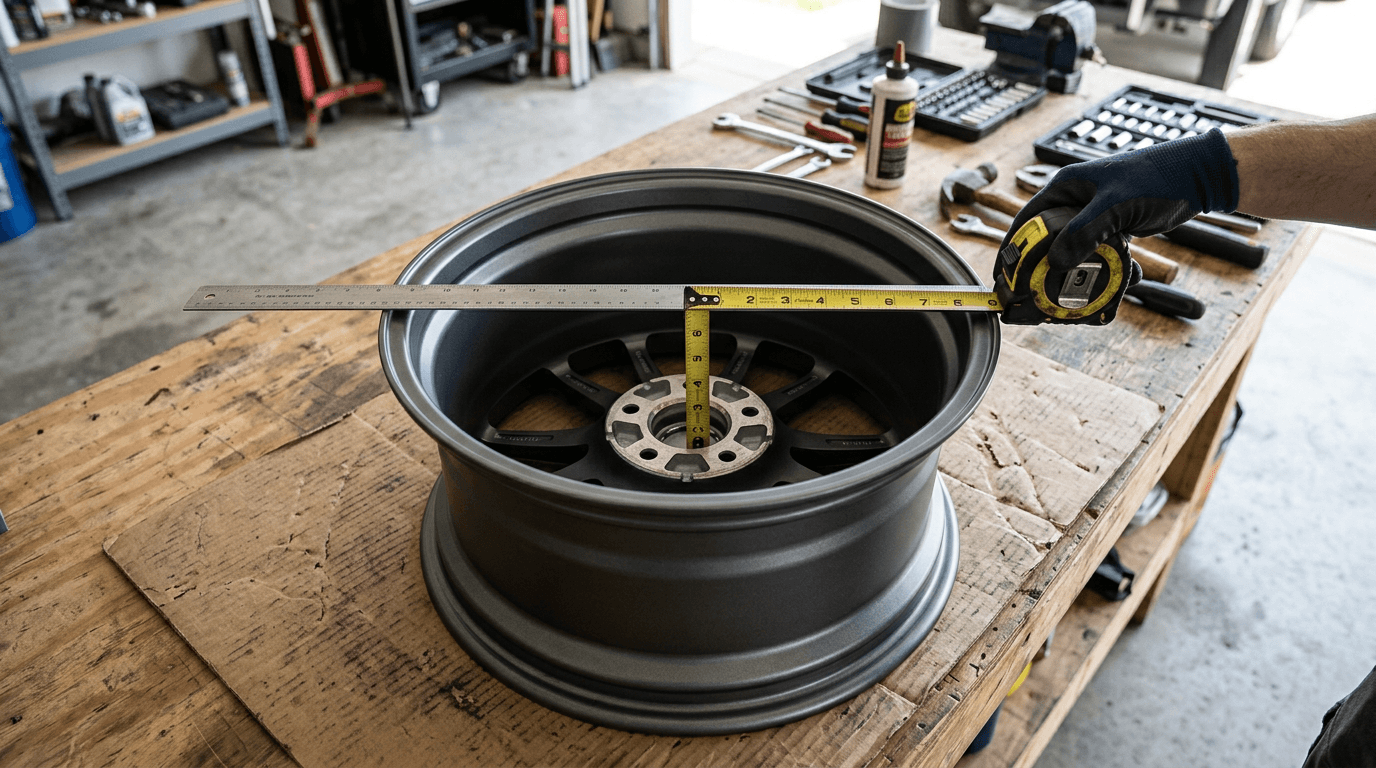
- Set the wheel face down on a flat, protected surface.
- Lay a straight edge across the inner lip.
- Measure to the mounting pad. That distance is your backspacing.
Clearance checklist before you buy
- Inside: strut, control arm, and brake caliper clearance.
- Outside: fender lip, liner at full lock, and bumper tab clearance.
- Tires: same nominal size can fit differently across brands and models.
- Alignment: camber and toe can change poke/tuck and rubbing risk.
Offset and backspacing FAQ
Short answers to common fitment questions.
Want to test this on your own car photo?
Use the AI wheel visualizer to compare options and check how changes look before buying.